Plaster Wall Repair
Cracked, bulging or crumbling plaster cut back and filled with a drywall insert, then skimmed flat.
How plaster patching works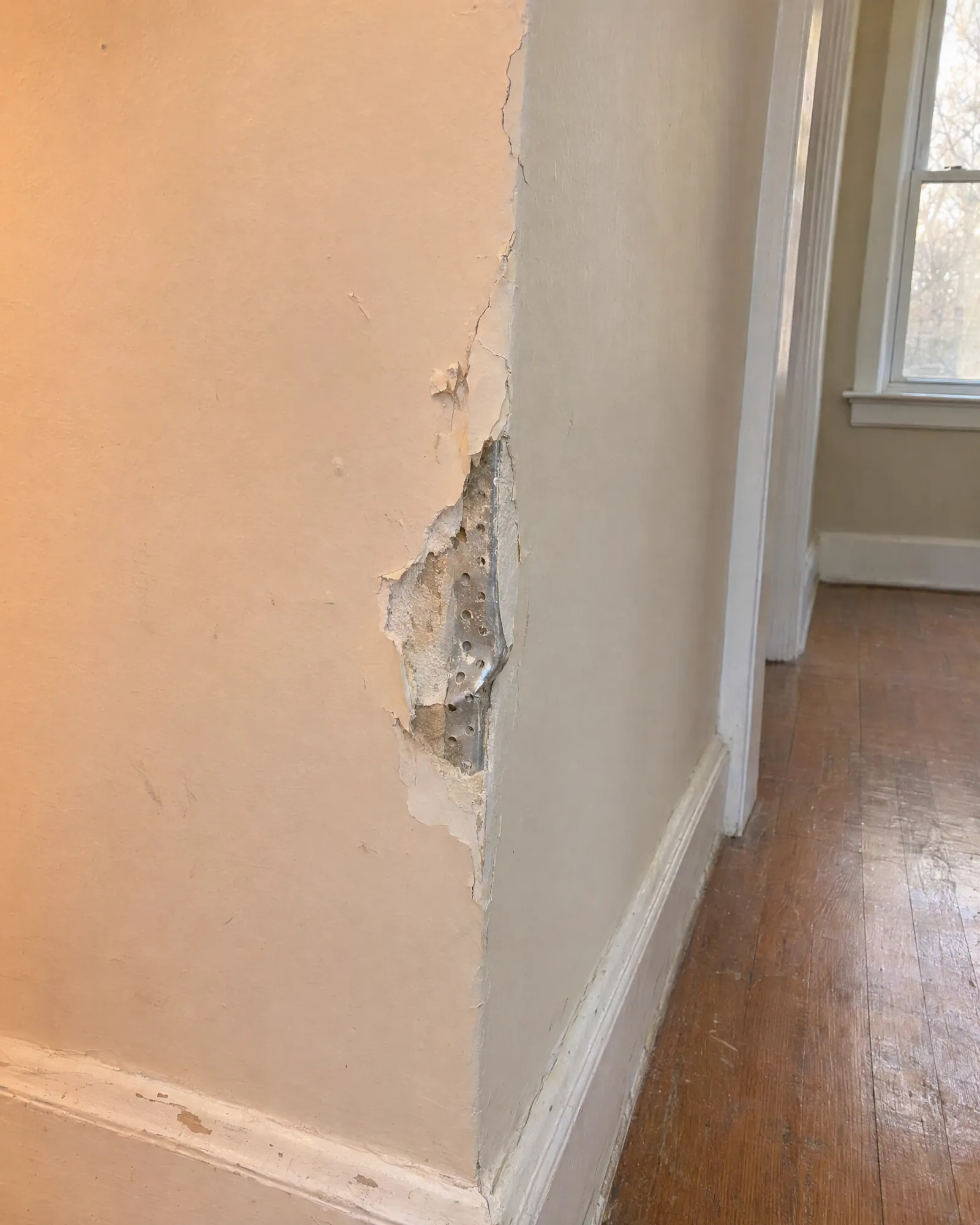
Cracked plaster, stained ceilings, punched-through drywall and chipped corners, patched and textured to blend in, ready to vanish under a fresh coat of paint.
A local plaster and drywall pro calls you back, looks at the damage and prices the fix before anything is touched.
What do you actually get fixed here? Four things, mostly, and they overlap. A plaster wall with a crack running off the door frame and a basement wall that soaked up water need different fixes, so each has its own page explaining what causes it and what a sound repair looks like. If your wall has two of these problems at once, that is normal in an older house, and one visit can price both.
Cracked, bulging or crumbling plaster cut back and filled with a drywall insert, then skimmed flat.
How plaster patching worksBrown rings, peeling tape lines and recurring cracks, repaired and sealed so the stain stays gone.
What ceiling stain repair involvesWicked-up board, swollen bottoms and dented walls below grade, replaced after the framing has dried out.
Basement wall repair, explainedDoorknob holes, fist-sized breaks and outside corners chipped down to the metal bead, patched and finished.
Patching holes and broken cornersWhy does any of this matter in Elmwood Park? Because the houses here are older than most people assume. Census figures for the village put more than a quarter of its homes before 1940, and roughly six in ten before 1960. The village itself was incorporated in 1914. So a lot of the walls you live with were never drywall at all. They are plaster troweled over wood lath, and they behave differently when they crack.
Here is what that usually means for a repair:
None of this means plaster has to come out. Most of the time the right move is to cut back only the loose part and fill it with drywall, which is what the plaster patching page walks through.
Which repair does a damaged plaster or drywall wall need? It depends on how much of the wall is still sound. Here are the three usual answers side by side.
| Question | Drywall insert | Skim coat over the wall | Tear out and hang new board |
|---|---|---|---|
| What gets opened up | Only the loose or broken patch, cut to a clean square | Nothing; the surface is coated where it stands | The whole section, down to studs or joists |
| Dust and mess | Low; a small cut and light sanding | Moderate; sanding across a full wall | Highest; old plaster and lath come out in bags |
| Visits, usually | Two or three, for coats to dry | Two or three, depending on thickness | Three or more, with hanging, taping and coats |
| How the edge reads after paint | Invisible once feathered wide and primed | No edges at all, the wall is one surface | Invisible, but the new section can feel flatter than old walls beside it |
| Best when | One area is damaged and the rest is solid | Many fine cracks, but the plaster is firmly attached | Large areas are loose, wet or falling |
So for most single cracks and holes the insert wins. A skim coat makes sense when a wall looks like a road map but is still tight to the lath, and full replacement is for walls that have truly let go.
Can you just fix it yourself? Sometimes, honestly, yes. Here is a fair split.
The tricky part of DIY is not filling the hole; it is getting the patch flat and invisible with sunlight skimming across it from a window. If you have tried twice and can still see it, that is usually the moment to hand it off.
Why do basement and garage walls get their own rules? Because the board down there deals with moisture and knocks that upstairs walls never see.
In a basement, drywall that touches the slab drinks water like a sponge, and the damage often shows as a swollen, crumbly band along the bottom. The fix is to cut the board out above the wet line, let the framing dry, and replace it with moisture-resistant board held up off the concrete. If the wall is still damp when you press a hand on it, the honest answer is to wait. Patching over wet framing just traps the problem.
Attached garages are a different concern. The wall and ceiling between a garage and the house are often built with Type X fire-resistant board, and a repair there should use the same kind of board so it keeps doing its job. Garages also collect car-door dings, bike handlebars and shelving that pulled loose; those are ordinary patches once the right board is in hand.
More on what happens below grade is on the basement wall repair page.
What will it cost? It depends mostly on size, because size decides how many coats, how many trips and how much texture work the repair takes. Here is the general shape of it.
Nail pops, a short crack, a hole no wider than a couple of inches.
Usually filled or backed and finished in two thin coats. The paint touch-up is often the slowest step, since compound must cure before primer goes on. Inch Calculator, a national cost guide, puts a small drywall repair at roughly $60 to $200 on average across the country.
A doorknob hole, a section of loose plaster, a chipped corner, a ceiling stain.
A cut-out and insert, or new corner bead, then three coats feathered wide. Expect a second or third visit for drying, and texture work if the wall is not smooth. The same guide lists $300 to $900 for a major repair or several smaller ones handled together.
Several feet of ceiling, a wet basement wall, a room of cracked plaster.
Board replacement or a full skim coat, more drying time and usually primer and paint across the whole surface so the sheen evens out. Larger areas are often priced by the square foot; Inch Calculator gives $50 to $80 per square foot as a typical professional rate.
Those are national averages, not prices for a house on your street. What moves the number up or down here: plaster versus drywall, ceiling height, texture, whether the paint has to be carried corner to corner, and how easy the room is to work in. The real figure comes from the pro who sees your wall.
How messy is this going to be? Less than you fear, if the room is set up first. Here is what a careful repair looks like before any cutting starts:
If you have pets or someone at home with asthma, say so when you call. It changes how the room is closed off and when the sanding happens.
Do you need to fix every mark before you hand over the keys? No. Census figures show more than a quarter of the homes in the village sit in buildings of five or more units, and nearly one in five is in a two- to four-unit building, so a lot of walls here change hands with each lease. Here is what is worth doing.
If your schedule is tight, tell us the move-out or listing date when you call, and the visit can be set up around it.
What is that thing on your wall telling you? Here are the usual suspects and where to read more.
Where do repairs get done? Throughout Elmwood Park, from the blocks near the Metra station to the houses at the edges of the village, and in the villages around it. River Grove and Melrose Park share borders with Elmwood Park, as do River Forest and Oak Park, and Franklin Park, Norridge and Harwood Heights are close by. Each one has a sentence or two of its own on the page listing the towns served.
Not sure which kind of repair you have? You do not need to know. Describe what you see, add the town or ZIP, and a local pro takes it from there: a look at the wall, a firm quote up front, then the patch finished, sanded and ready for your paint. The steps from first description to primed patch are laid out on their own page, and a short set of care guides covers what to note before you call.
Calling gets you a straight answer on the wall and a visit set up to price it.
Call 7 days, 7am–9pm
Send it, and you are fine with this wall's pro using phone and text to follow up. Privacy
The pro who takes your wall reads what you wrote, then calls to set a time to see it in person.